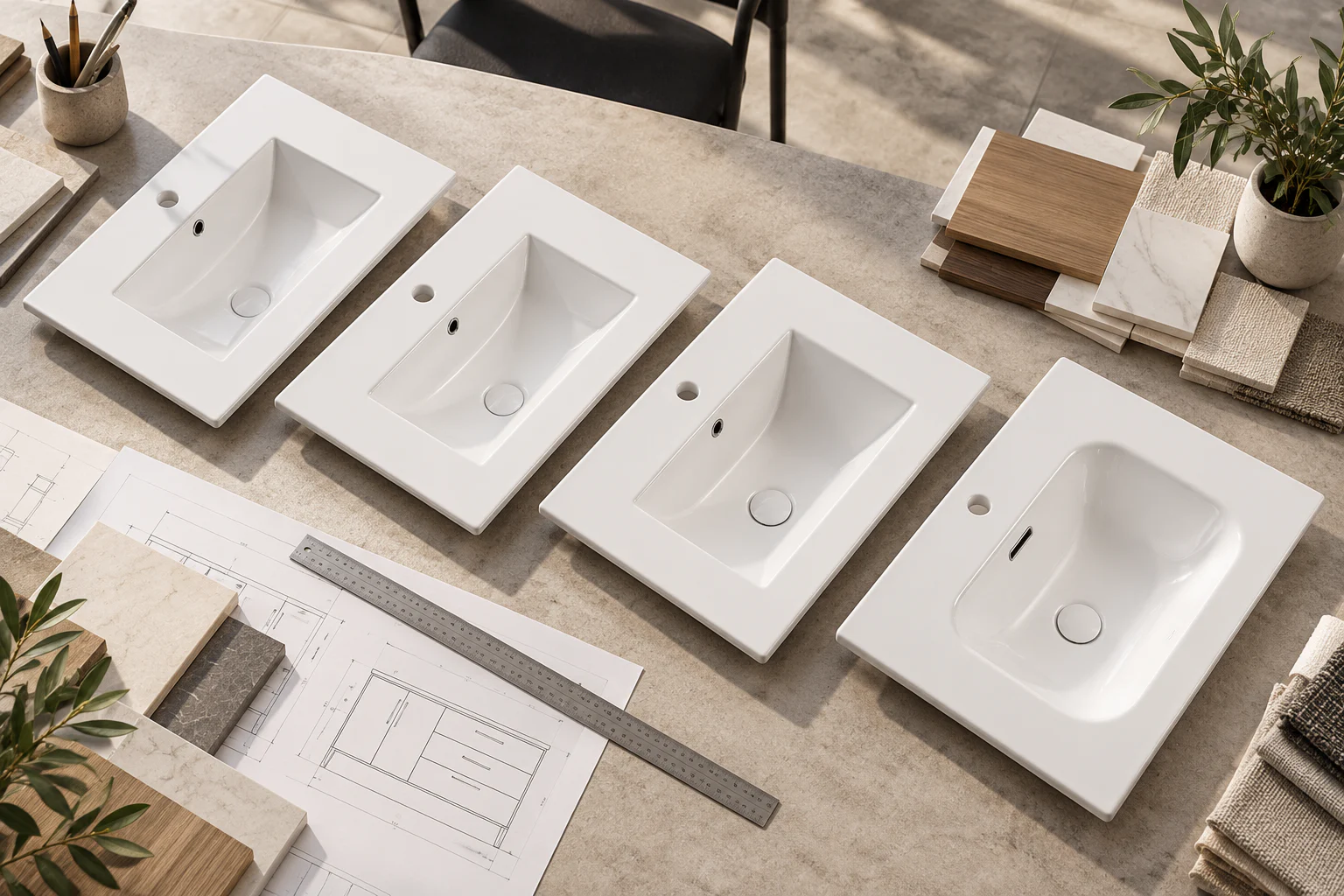
Depth is the front-to-back measurement of the ceramic top, not the cabinet's usable internal depth. Start with the finished cabinet and wall condition, then compare the exact model drawing. The CADIA catalogue includes E5136 at 513 × 365 × 165 mm, E5139 at 510 × 395 × 170 mm, E61 at 610 × 465 × 170 mm and D6050 at 610 × 510 × 180 mm. These examples show why a similar width does not imply a similar depth.
Measure the installed position
Record the cabinet's finished front-to-back dimension, the back edge against the wall, any wall finish or skirting, and the desired front projection. Mark the faucet and mirror clearance on the same plan. A top that fits the nominal cabinet depth may still interfere with a wall-mounted fitting or project farther than the design allows.
Compare the actual bowl envelope
Read the plan and section drawing for each shortlisted model. Check where the bowl begins and ends, the rear ledge for the tap, and the position of the waste relative to the cabinet rails. The overall depth alone cannot tell you whether a drawer will close or a trap will clear. Ask for the current drawing of the exact model and finish before cutting cabinet parts.
Make the selection explicit
Send the supplier a marked cabinet plan with the chosen top depth, proposed model, faucet type and installation method. Ask them to confirm the edge relationship and any dimensional tolerance shown on that model's drawing. If a standard depth conflicts with the cabinet, resolve the cabinet design or discuss a model-specific change before a purchase order is released.
The four example sizes above come from the current CADIA product data. Cabinet overhang and installation clearances must be agreed for the actual project.
Request Catalogue →